
WASHINGTON, D.C. — As U.S. electricity demand grows at its fastest pace in decades, a new report from the National Hydropower Association (NHA) further confirms that the federal licensing process governing the nation’s hydropower fleet has become steadily more burdensome and increasingly disconnected from energy production. This threatens hydropower’s reliability and affordable power at a time when consumers need it most.
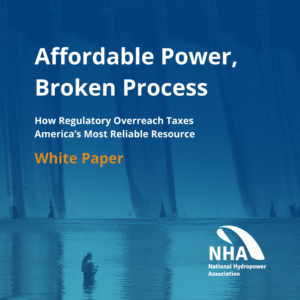
To read the full report, click here
Key Findings
In a first-of-its-kind analysis, NHA reviewed more than 5,000 mandatory conditions across 4,819 licensing documents filed between 1980 and 2026 in 46 states. These mandatory conditions are legally binding requirements imposed by federal or state resource agencies that a project developer must accept and fulfill to receive their final operating license.
Compared against their own earlier licenses, hydropower facilities now carry roughly ten times as many mandatory conditions. Fewer than 15 percent of those conditions include any cost estimate at all, and the vast majority of all projects have an open-ended “reservation of authority,” meaning licensees often don’t know the final terms of their own license until years into the process. To make matters worse, many conditions are unrelated to energy production and are essentially “wish list” items that hydropower producers are asked to fund, ranging from road construction unrelated to the projects to building fish passage far beyond where the fish actually are (or even could be).
Because the process doesn’t scale with project size, NHA’s analysis shows the burden falls hardest on smaller plants. Over the next decade, 348 hydropower permits representing over 12,000 megawatts (MW) of capacity are due for relicensing, and many of them are the small, high-flexibility plants now at risk of shutting down rather than navigating the expensive and time-consuming process.
“I urge anyone who cares about reliable, affordable power to read this groundbreaking study,” said NHA’s President and CEO, Malcolm Woolf. “Hydropower, a superhero of the grid and an American icon of energy production, is at great risk due to a broken regulatory framework. Relicensing an existing hydropower facility often takes decades and costs millions of dollars. If these facilities go away, so does the affordable power they produce, the good jobs they create, and the critical infrastructure and ecosystem care they provide. NHA’s analysis of mandatory licensing conditions highlights a big part of this challenge and, perhaps most importantly, charts a path forward to unleash new hydropower resources.”
Hydropower’s Role
The nation’s 80 gigawatts (GW) of conventional hydropower and 22 gigawatts of pumped storage are found in 48 states and serve roughly 30 million Americans. The resource provides reliability services no other renewable resource can match, including the ability to restart the grid after a blackout. It boasts more than 80% of America’s long duration energy storage and provides important support to other variable energy sources like wind and solar. Beyond these energy services, hydropower also provides critical infrastructure like irrigation and flood control and supports recreation sites across the country.
Focused Policy Solutions
Under current law, FERC cannot reject or modify conditions imposed by four other federal agencies across three Cabinet departments under Sections 4(e) and 18 of the Federal Power Act, so other policymakers must act.
Executive action: President Trump’s Executive Order 14154, “Unleashing American Energy,” names hydropower as a priority resource and directs agencies to remove undue burdens on domestic energy development. Acting on that authority, the Secretaries of Agriculture, Commerce, and the Interior could immediately limit key conditions to a project’s direct effects and open rulemakings, including a clear definition of “fishway” to make that standard stick.
Legislative action: The Hydropower Licensing Affordability Act, introduced by Rep. Cliff Bentz (OR-02) in the U.S. House and Sen. Steve Daines (R-MT.) in the U.S. Senate, would tie mandatory conditions to a project’s direct adverse effects and bar agencies from imposing costs without regard to benefit, giving the reform permanent statutory footing.
About NHA
The National Hydropower Association (NHA) is the only national association representing the interests of the entire U.S. hydropower and marine energy industries. Our members are dedicated to maintaining and expanding hydropower as an affordable, reliable, and clean source of electricity. Learn more at hydro.org.

