
Phoenix, AZ — The National Hydropower Association (NHA) awarded Salt River Project (SRP) and McMillen with the inaugural Achievements in Water Power Awards at Clean Currents 2026 in Phoenix, Arizona.
The Achievements in Water Power Awards celebrate organizations from across the U.S. water power industry, recognizing projects and programs that advance innovation, enhance environmental and recreational outcomes, and strengthen public understanding of water power.
This year’s honorees had something unique in common, as both demonstrated a willingness to take on first-of-their-kind challenges and share those lessons with the rest of the industry.
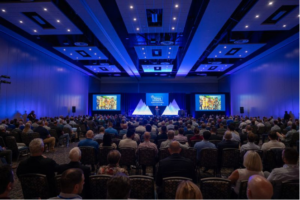
NHA’s Clean Currents 2026 Plenary
Salt River Project
In 2025, Salt River Project became the first U.S. utility to install a convergently manufactured hydropower wicket gate, the adjustable vane that controls water flow into a turbine. The gate was installed at the century-old Horse Mesa Dam during a planned outage, moving additive manufacturing in hydropower from research and demonstration into operational reality.
The challenge SRP tackled is one shared across the country, as U.S. hydropower assets average about 65 years old, and many legacy components are replaced on long, infrequent maintenance cycles. By the time a part needs replacing, the original manufacturer drawings may be gone, and the original suppliers may no longer exist. Casting, the traditional method, brings long lead times, and for some 100-year-old designs, no molds survive at all.
In partnership with EPRI’s advanced manufacturing research, SRP used wire arc directed energy deposition (DED), a method suited to large parts, in a “convergent” build. Rather than printing the entire gate, the team deposited the gate’s leaf onto a forged stainless-steel shaft. By pairing a conventionally made shaft with a printed leaf, the approach cut wire use and print time by about half and reduced machining.
The results were significant across lead time, cost, and performance. Delivery dropped from roughly 30 months for cast gates to six months for the full project, including EPRI testing, and future, similar parts are expected in under six months. The first fabrication cost about the same as casting, compared with an estimated 1.5 to 2 times casting costs for a fully printed part. With optimization across multiple gates, the convergent approach could reach about 75% of casting costs.
The part also met or exceeded American Society for Testing Materials’ material requirements, with fewer and smaller internal defects than accepted cast parts, and EPRI’s testing confirmed it was fit for service. For owners and operators managing aging fleets, that means a scalable, repeatable way to reduce supply chain exposure and manage legacy assets more economically.
Just as important as the technical result were the decisions motivating the project. SRP took on informed technical risk, set rigorous acceptance criteria for a first application, and is sharing its findings openly through Clean Currents, EPRI forums, and publications. That openness gives utilities nationwide a blueprint for tackling long lead times and aging infrastructure.
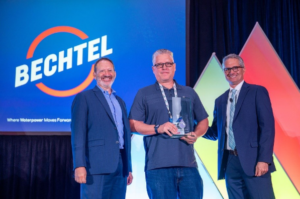
Matthew Pendergraft (center), Director of Hydropower Generation at Salt River Project, receives the award from NHA President and CEO, Malcolm Woolf (left) and Director of Regulatory Affairs at New York Power Authority and NHA Board Chair, Alan Michaels (right).
McMillen
The Klamath River Renewal Project, which spanned Oregon and California, was the largest river restoration and dam removal effort in the world, and McMillen served as the engineering force behind the effort, guiding a project with no precedent.
Success at this scale required consensus, bringing more than 40 stakeholder groups to the table from across multiple states, counties, and cities, including Tribal Nations, agricultural communities, regulators, utilities, conservation groups, and energy interests. Through transparent communication and shared decision-making, the groups aligned around a common path forward.
McMillen translated competing priorities into data-driven analyses, risk-informed designs, and carefully sequenced construction, giving every stakeholder a shared, objective basis for decisions.
As no project of this size had been accomplished before, the effort demanded new techniques. The dams had held back millions of cubic yards of sediment and releasing it all at once could have threatened the very ecosystems the project was meant to restore, as well as the downstream communities dependent on the river. McMillen developed new methods for the controlled release of that sediment, protecting downstream systems and communities throughout the process.
Advanced hydraulic and sediment transport modeling guided both drawdown timing and construction sequencing. These models allowed the team to weigh short-term risk against long-term ecological recovery, ensuring that each phase of work moved the project closer to the end goal.
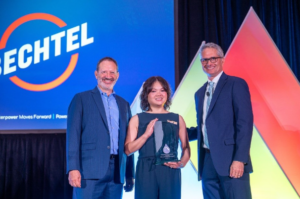
Canada Market Lead for McMillen, Merry Dang (center), receives the award from NHA President and CEO, Malcolm Woolf (left) and Director of Regulatory Affairs at New York Power Authority and NHA Board Chair, Alan Michaels (right).
For More Information
To learn more about the award-winning projects, check out the following videos NHA made to highlight SRP and McMillen’s work.
To learn more about the Achievements in Water Power Awards, visit the page here; the next award cycle will begin in early 2027.

