

 Back to All
Editor’s Note: Clean Currents 2026 includes a half-day tax credit workshop with a variety of expert faculty. Join us in the desert on Tuesday, September 22, 2026, to learn more and discuss this once-in-a-generation infrastructure investment opportunity!
This article offers an overview of federal tax credits – and direct pay for public power! – available to new and existing hydropower projects that meet certain benchmarks by 2033. Qualifying projects receive 30 to 50 percent of a project’s cost, or millions annually in generation incentives. Contrary to headlines, hydropower still can receive billions in federal incentives for clean energy!
Use the links below to quickly navigate through the article’s sections:
Opportunities for Existing Facilities
Bonus Credits: Substantial Upside, Requirements for Public Power
All Non-Federal Entities May Now Access Credit Value
Watch Your Supply Chain: Foreign Entity of Concern (FEOC) Rules
WHAT IS THE OPPORTUNITY?
The Inflation Reduction Act of 2022 (IRA) represented the most significant expansion of federal financial incentives for clean energy in American history, including hydropower. Yet it wasn’t until January 2025 that the U.S. Treasury Department clarified that they apply to both new hydropower and pumped storage hydropower (PSH) projects and, notably, existing hydropower projects that are “repowered.” These changes, which were preserved in the Trump Administration’s One Big Beautiful Bill Act (OBBBA) from July 2025 that eliminated credits for other technologies, create unprecedented federal support for investments in new and existing hydropower, PSH, and marine energy.
With the IRA’s establishment of direct pay (aka elective pay) and transferability (the ability to monetize credits even if you do pay taxes in a given year), public and other entities without tax obligations now qualify for significant federal support toward new and repowered hydropower projects if they begin work before 2033.
In short, qualifying water power investments are eligible for investment tax credits (ITC) ranging from 30-50 percent of the investment. For repowered projects, investments that are “integral” to the safe operation of the facility also qualify for the tax credit. At the same time, many hydropower operators are discovering that the alternative production tax credit (PTC) is even more generous depending on project operations.
Don’t leave money on the table! If your organization hasn’t already evaluated how to maximize these federal tax credits at your facilities, what are you waiting for?
WHAT DO THE TAX CREDITS DO?
Depending on when your facility was placed in service, slightly different rules apply. In general, all projects that began construction since passage of the IRA in 2022 should be evaluated for potential tax credits.
If Construction Began Before January 1, 2025
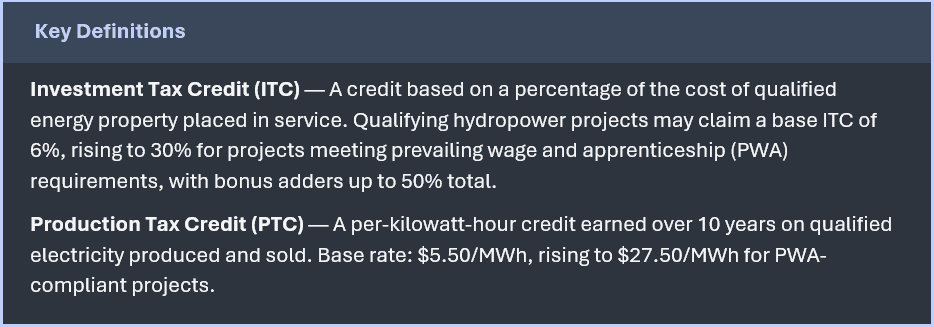
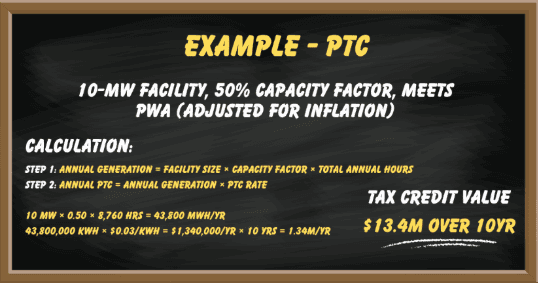
The Production Tax Credit (PTC) and Investment Tax Credit (ITC) are available for facilities that began construction before January 1, 2025. The PTC is earned over a 10-year period based on electricity produced and sold, with a base rate of $5.50 per megawatt hour (MWh) — rising to $27.50/MWh for facilities that meet prevailing wage and apprenticeship (PWA) requirements.
The IRA also eliminated the previous one-half rate reduction that had long applied to hydropower, meaning facilities placed in service after December 31, 2022, receive the full credit rates. The ITC, which a qualifying facility can elect in lieu of the PTC, provides a base credit of six percent of eligible project costs, rising to 30 percent for PWA-compliant projects. Notably, the IRA properly recognizes pumped storage hydropower (PSH) as storage technology, making it eligible for the ITC.
If Placed in Service Began After January 1, 2025
A key innovation in the IRA was a shift to two new technology-neutral credits: the Clean Electricity PTC and the Clean Electricity Investment Credit. In other words, the focus shifts to a focus on outcome or performance (clean electricity) rather than a specific generation technology (e.g., wind or solar). Hydropower is a zero-emissions technology under both and does not require a facility-specific emissions analysis. Both apply the same rate structures as the previous credits. Of note, while the OBBBA terminated these credits for wind and solar, it left hydropower intact, instead establishing a phaseout from 2032 to 2036.
OPPORTUNITIES FOR EXISTING FACILITIES
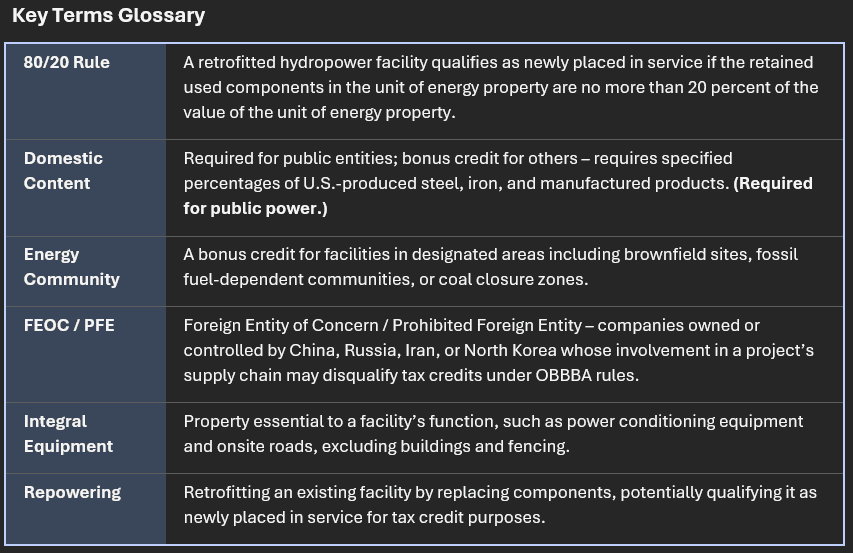
Repowering
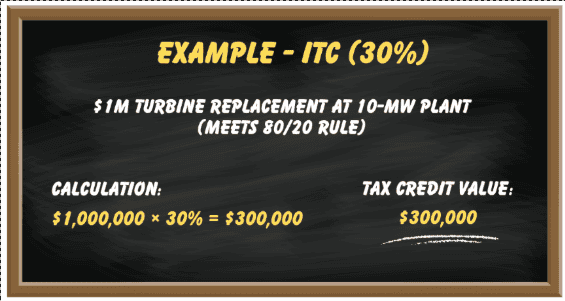
The 80/20 Rule offers another powerful pathway. If the value of new components represents at least 80 percent of a retrofitted facility’s total value, the entire facility is treated as newly placed in service — qualifying for credits on all production, not just the incremental portion. The final regulations clarified that for hydropower, the 80/20 analysis applies to the core generating components (water intake, isolation mechanisms, turbine, pump, motor, and generator) and does not extend to integral property like the dam — a narrower scope that is generally easier to achieve.
Projects that Increase Capacity
For upgrade and modernization projects under the new Sections 45Y and 48E of the tax code, a new unit or addition of generating capacity at an existing facility is treated as a separate qualified facility, unlocking a new 10-year credit period even if the existing facility previously claimed credits under Section 45 or 48.
The key test is whether physical components were added or replaced that result in an actual increase in electrical generating capacity, documented through a Federal Energy Regulatory Commission (FERC) license amendment or comparable means. Pure efficiency improvements that do not increase capacity do not qualify under the newer credits, though they may still qualify under the older Section 45 for facilities that began construction before 2025.
For the Section 48E ITC specifically, the final Treasury regulations — shaped in part by comments from the National Hydropower Association (NHA) — made a major improvement: facility owners may now claim the ITC on their total investment in qualifying new components, not merely a proportional fraction tied to incremental output. This is a significant win for those investing in substantial facility modernization.
BONUS CREDITS: SUBSTANTIAL UPSIDE, REQUIREMENTS FOR PUBLIC POWER
Beyond the base credit rates, the IRA layers on several bonus credits that can dramatically increase total value.
Building the skilled energy workforce was a key aim of the IRA. Thus, to claim full ITC/PTC credits, projects must meet prevailing wage and apprenticeship (PWA) rules. The requirements apply during construction and continue through the post-placement alteration and repair period.
Domestic Content
Using sufficient levels of domestic content is required for public entities and optional for others, although its use earns a significant bonus credit. Meeting Domestic Content earns taxable entities an additional 10 percent ITC or $2.75/MWh PTC for using domestically produced steel, iron, and manufactured products. For hydropower, this includes the turbine/pump runner, motor/generator, and generator step-up transformer for hydropower facilities. The required domestic content threshold is 55 percent for facilities beginning construction after 2026.
For public power entities, tribal governments, rural cooperatives, and other organizations using the elective payment mechanism, domestic content is not a bonus — it is effectively a prerequisite. Failure to meet domestic content requirements triggers a phased reduction: 10 percent for facilities beginning construction in 2024, 15 percent in 2025, and a complete elimination — 100 percent reduction — for facilities beginning construction after December 31, 2025. Treasury has extended transitional relief through 2026, but further extensions are not expected. Public power entities must treat domestic content compliance as a core project planning requirement.
Facilities located in an energy community — which includes brownfield sites, areas with fossil fuel employment or tax revenue history, and communities affected by coal mine or power plant closures — qualify for an additional 10 percent ITC or $2.75/MWh PTC. The U.S. Department of Energy maintains an online mapping tool to help organizations determine eligibility.
In total, a fully optimized hydropower project could qualify for an ITC of up to 50 percent of eligible project costs.
ALL NON-FEDERAL ENTITIES MAY NOW ACCESS CREDIT VALUE
The IRA created two mechanisms that fundamentally change who can benefit from energy tax credits – meaning all hydropower entities should evaluate planned and potential projects.
- Elective payment or direct pay allows tax-exempt organizations, state and local governments, tribal governments, and rural electric cooperatives to receive a direct cash payment from the IRS equal to the applicable credit amount. For publicly-owned utilities, municipal power authorities, and cooperatives, this is transformative.
- Credit transfer (aka transferability) allows taxable entities to sell their tax credits directly to unrelated buyers. This dramatically expands credit monetization beyond the limited pool of traditional tax equity investors. Credits must be sold for cash, and both the seller and buyer must comply with specific registration and documentation requirements. As of this writing, credits were transferring at approximately 90 cents on the dollar.
Both mechanisms require advance completion of the IRS’s electronic pre-filing registration process before the applicable tax return is filed, and sh0uld be done in coordination with a tax professional.
WATCH YOUR SUPPLY CHAIN: FOREIGN ENTITY OF CONCERN (FEOC) RULES
The OBBBA introduced a new set of restrictions that will affect facilities claiming Section 45Y or 48E credits where construction began after December 31, 2025. Facilities that receive “material assistance” from prohibited foreign entities (PFE) — primarily companies owned or controlled by China, Russia, Iran, or North Korea — risk full disallowance of their tax credits.
The rules phase in through a material assistance cost ratio (MACR) that measures the share of total manufactured product costs attributable to prohibited foreign sources. For hydropower facilities, the allowable share of prohibited-source costs starts at 60 percent in 2026 (meaning at least 40 percent must come from non-prohibited sources) and tightens to 40 percent by 2030. Pumped storage hydropower, as energy storage technology, faces stricter thresholds — only 25 percent prohibited-source content permitted by 2030. Treasury is required to issue safe harbor guidance by the end of 2026 (it had not yet been issued at the time of this writing).
WHAT’S NEXT?
While we await publication of the safe harbor table, which will establish presumptive component ratios for use in calculating domestic content and MACR thereby easing confirmation of compliance, entities may use the credits now (and some have already received multi-million dollar checks for work completed since passage of the IRA).
This article provides a general overview only and should not be relied upon as legal or tax advice. For organizations that are members of the National Hydropower Association, NHA provides access to a comprehensive handbook on federal tax credits. All organizations should consult their own legal counsel or tax advisers regarding their specific circumstances and eligibility.