

 Back to All
*Sponsored Content
This article completes a three-part series on upgrading hydropower operations. Part one focused on optimizing asset performance via digitalization and data analysis. Part two discussed how to establish a programmatic approach via a Program Management Office (PMO). The following gives an overview on operating an effective PMO.
A PMO is a strategic tool for hydropower producers seeking to overcome resource constraints while navigating capital improvement projects (CIPs), regulatory requirements and sustainability goals. An effective PMO aligns projects and processes with owners’ strategic objectives and applies best management practices, all under the guidance of experienced industry professionals.
HOW A PMO SUPPORTS HYDROPOWER PROJECT EXECUTUON
Modernization and upgrade projects are a growing priority for hydropower producers. Yet competition for limited resources – especially with aging workforces and skilled labor shortages – impede progress. Other constraints range from capital and funding limitations to water availability fluctuations and climate variability. Altogether, these constraints make managing complex capital projects difficult without structured support.
Enter the PMO. It assumes responsibility for prioritizing, initiating, and executing projects while monitoring and controlling resources. From planning and design to construction and closeout, a PMO standardizes processes, performance metrics and reporting tools, handling the nuances of projects at every stage. It couples structured oversight and coordination with technical expertise to reduce risks, optimize workforce allocation and improve both cost and schedule accuracy.
PMOs offer a versatile solution that can establish project execution processes from scratch in resource-constrained environments or seamlessly integrate with owners’ staff to provide specialized support for large-scale programmatic initiatives. By adapting to the unique needs of each project, PMOs play a critical role in overcoming obstacles and ensuring successful project delivery.
WHY HYDROPOWER MODERNIZATION NEEDS A PMO
Hydropower systems across the country are aging and outdated, falling short of ever-increasing performance demands. Upgrading the capacity and capabilities of facilities to extend their operational lives is generally preferred to building new. This includes staying compliant with evolving environmental and safety regulations, making the most of digital technologies and managing risk.
PMOs with deep technical expertise in hydropower and heavy construction can identify risks early and manage them effectively. A robust program management framework supports:
- Early issue detection
- Budget adherence
- Informed decision-making
- On-time delivery
- Regulatory compliance
- Efficient resource use
- Stakeholder engagement
Additionally, environmental and safety practices the PMO may oversee include:
- Task-specific job hazard analysis
- Environmental safety assessments
- Safety audits
- Comprehensive training programs
In addressing these integrated goals and challenges, power producers can find the resources they need in an agile, service-minded PMO.
KEY COMPONENTS OF PMO OPERATION
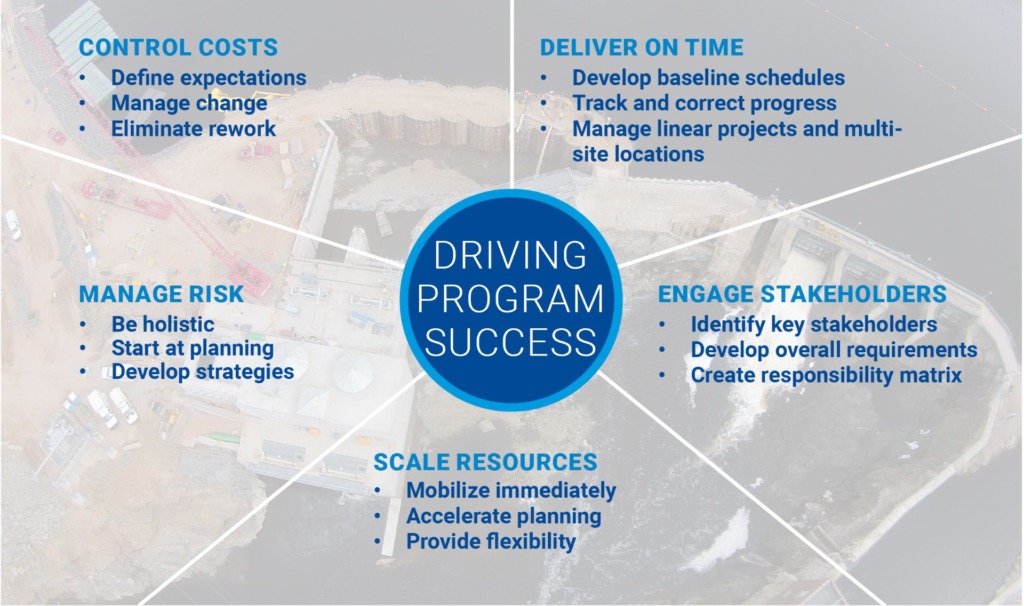
Step one is establishing the program. Step two is establishing the PMO itself. Next is operating the PMO to drive certainty in outcomes. The key elements of PMO operation include:
Project prioritization and planning
Goal: Standardize and streamline project planning.
How: Create comprehensive project handoff packages that encompass scope, schedule, budget, permitting needs, procurement plans and risk assessments. Utilizing the same tools and basic structure for multiple projects streamlines the effort allowing the project managers to be more efficient and effective.
Project initiation
Goal: Kickoff projects with clarity and stakeholder alignment.
How: Review prior analyses, define objectives, establish communication channels, and develop risk registers. Having consistent tools allows the project manager to use data more easily from a previous project and make it relevant to the next project.
Project delivery
Goal: Stay on track with scope, schedule, budget, and risk mitigation.
How: Lead reviews, document progress, plan resources and track lessons learned. With consistent metrics and performance dashboards, the project manager can quickly assess status and share it easily with the execution team or executive reviewers using real time data rather than having to stop progress to generate reports.
Transition of operations
Goal: Transition the PMO for long-term operation.
How: Identify staffing needs and requirements and provide training, documentation and resources including standard operating procedures, templates, and best practices. A well-established PMO leaves a legacy of strong project execution that the next team can use as a guide and reference.
THE PMO: DRIVING STRATEGIC SUCCESS FOR HYDROPOWER PRODUCERS
PMOs serve as a bridge between executive strategy and on-the-ground execution, connecting every project in the capital improvement program to broader performance goals. They provide structure, insight and leadership across all project phases to support more efficient delivery, cross-functional collaboration, and real-time analytics and reporting.

