
 Back to All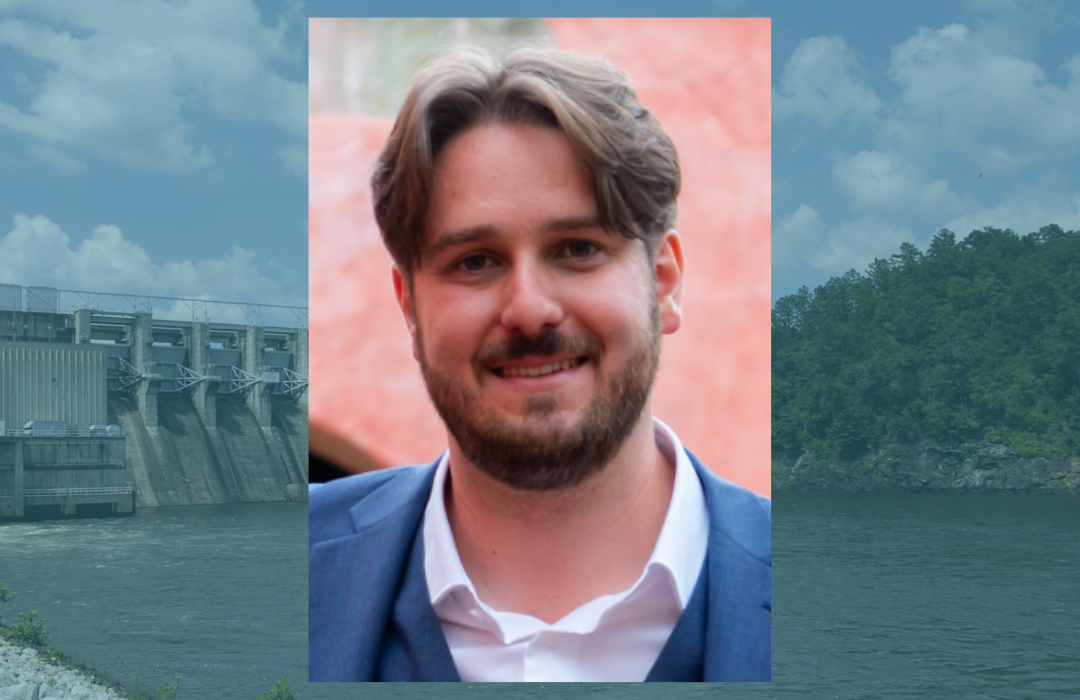
This article is part of a series titled “Shaping the Current: A Spotlight on Hydropower’s Future Leaders,” that aims to highlight voices of emerging leaders in hydropower.
Robert Schomp spends his 9-to-5 as a Project Engineer at Kleinschmidt, building hydraulic models and occasionally trading his desk for a trip to remote field sites in Alaska to survey salmon habitats. But he spends plenty of hours outside that role too — teaching an introductory engineering class on weeknights at Clackamas Community College, volunteering for K-12 outreach at every grade level, and now chairing a national committee on career pipelines for the American Society of Civil Engineers.
For Schomp, hydropower’s biggest recruiting problem isn’t a lack of interesting work; rather, it’s a lack of visibility. Most people, he says, have simply never seen what the job looks like.
The Hydropower Foundation team caught up with him to talk about why he spends so much of his time outside his day job trying to fix that.

POWERHOUSE: Tell us about your day job. What’s your title, and what does Kleinschmidt have you working on?
Robert: I was promoted recently to Project Engineer. My day looks like working on computer models on the analysis side: building hydraulic and sediment transport models, using the HEC-RAS software. I work on analyzing models that are then simulated, usually for dams that need to relicense, update, or replace parts of their infrastructure. I also get to do field work occasionally, which is my favorite part — mostly surveying for stream restoration and salmon habitat assessments, including a few trips a year out to remote sites in Alaska. Those trips are pretty fun, and the assignments are simple. For example, a question could look like: “This is what salmon habitat looked like 7 years ago. We changed the way our hydropower facility operates. What does it look like now?”
POWERHOUSE: On top of that full-time role, you also teach at Clackamas Community College. How did that start?
Robert: I teach Introduction to Engineering, which covers all engineering disciplines. I was originally asked to fill in for just one term while someone was on sabbatical, and I was so excited about doing that because I already do a lot of volunteering with K-12 outreach, so I said “yes” before I even knew what the schedule looked like. Luckily, they let me teach in the evenings, so I work all day and then go there and switch brains, but it’s been really rewarding.
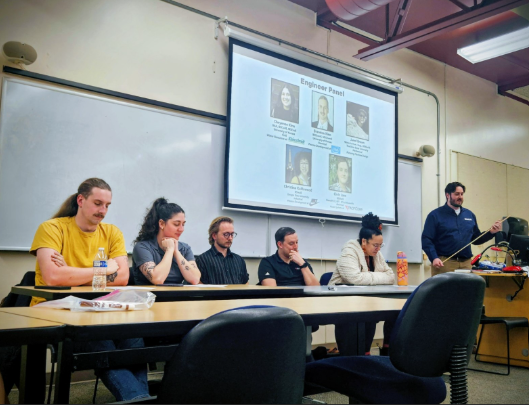
POWERHOUSE: Who’s actually in that classroom?
Robert: It’s a good mix of students. About a third of my students are co-enrolled in high school, another third are true college freshmen, and a third are people returning to school from other fields or industries. My only job is to try to capture their interest in whatever type of engineering they want to do. I’m allowed to be biased — nearly all my examples are about hydropower, even when I’m teaching electrical or mechanical concepts.
POWERHOUSE: You mentioned that you’ve done a lot of K-12 outreach. What does that actually look like at different grade levels?
Robert: It really depends on the grade. At the high school level, it’s mostly “day in the life” presentations — showing pictures of me in the field, showing models I’ve built, and just letting students ask questions about what water resources engineering actually looks like day-to-day. I think that’s one of the most important things you can do at that age: connect with students directly, show them what you do, and offer to be a mentor.
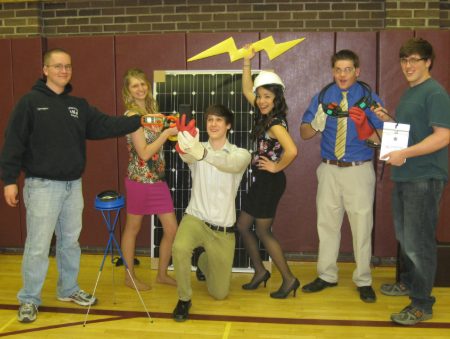
At the middle school and early high school level, it’s more hands-on. Through the American Society of Civil Engineers, we’ve done activities like levee optimization. I’ll give students a handful of popsicle sticks, some toothpicks, cotton balls, and a small ball of clay, all with a “cost” associated with them, and then ask them to build a levee that resists the flow of water using the least amount of material possible. It’s a great way to get them thinking not just about building something, but about the trade-offs involved in building it.
Elementary school is simpler. We do something called the colorful chemistry experiment, where you boil red cabbage in water, and it releases an indicator chemical. Once it’s boiled down, it turns purple, but adding an acid turns it pink, and adding a base turns it toward blue and green. To a group of elementary schoolers, that seems like magic. And it’s an easy way to tie into hydropower — reservoirs and rivers have real water chemistry, and so does the water that gets pulled for irrigation or drinking water. All it takes is giving a kid a bottle of lemon juice and stirring it up.
POWERHOUSE: You mentioned you’re also getting more involved at the national level. What’s that about?
Robert: I’m heavily involved with the American Society of Civil Engineers (ASCE), and I was elected chair of their committee on career pipelines and pathways earlier this year. ASCE is reorganizing to be more career-focused — I was previously involved in their K-12 outreach work, which was mostly STEM activities, and now this committee is specifically about building stronger pathways into the profession. It’s interesting that a lot of industries seem to be refocusing this way right now because there’s a real awareness that a wave of talent is going to be leaving these fields soon, and not enough young people even know the jobs exist.
POWERHOUSE: Why do you think that visibility problem exists specifically for hydropower?
Robert: Students can look at a road, a bridge, or a car and immediately understand what designing one might look like — those things are tangible and common. Not many people have the chance to visit a hydropower facility and see the inside of a turbine and think, “I want to design that.” If a student doesn’t happen to live near a dam or doesn’t have a mentor who happens to work in the industry, then hydropower simply doesn’t register as a career option, even though the work itself is genuinely interesting and pretty fun.
POWERHOUSE: What’s your favorite fun fact about hydropower?
Robert: The largest dam removal in U.S. history was the Klamath Dam removal, which restored nearly 400 miles of free-flowing river on what’s the third-largest salmon-producing river on the West Coast. I think it’s important to recognize that sometimes the right solution is removal — that not every facility’s benefit outweighs its cost.
POWERHOUSE: Any final thoughts?
Robert: I’d put out a call to action: if you work in hydropower, volunteer! The number one way to encourage students to pursue hydropower as a career is to show students that hydropower is a job. Visit a classroom or volunteer at a career fair and share what your job actually looks like. Most careers in this industry, if not all of them, are pretty fun — I get to make water models and help keep facilities running and improving. I think the number one reason students don’t consider hydropower is simply that it doesn’t look like a job to them yet.
Between a full-time engineering role, a weeknight classroom, and a newly elected seat on a national career-pipelines committee, Robert Schomp has made it his mission to close hydropower’s visibility gap one classroom at a time. His message to the industry is simple: the work speaks for itself, and it just needs someone willing to show it off.
WHAT COMES NEXT?
For students and professionals wondering how they might get more involved, Schomp’s answer is straightforward: Show up, share your story, and let the next generation see what the job actually looks like.