



 Back to All
Sponsored Content
Hydropower operators rely on forecasts every day. Whether the objective is maximizing generation value, managing reservoir storage, preparing for spring runoff, or maintaining dam safety, operational decisions are fundamentally tied to expectations about future inflows.
The challenge is that many watersheds feeding hydropower reservoirs remain only partially monitored. A typical reservoir may receive water from dozens, or even hundreds, of tributaries. While major rivers are often gauged, substantial runoff frequently originates from smaller tributaries, headwater basins, and remote snow-dominated watersheds where monitoring infrastructure is sparse or nonexistent. In many watersheds, operators have detailed information at a handful of locations and very little information everywhere in between. Machine learning (ML) models like HydroForecast from Upstream Tech make it possible to forecast streamflow in locations where no gauge exists. Here, we’ll focus on the practical implications of that capability.
Hydropower operators will always rely on public forecasts, watershed expertise, and operational experience. Machine learning forecasts are not intended to replace those tools. Instead, they provide new insights from an independent methodology, and can extend that visibility into ungauged portions of the watershed. This means a stronger toolkit that gives operators more opportunities to act early and reduce harm in the face of extreme events.
Why Ungauged Tributaries Matter
Most reservoirs receive inflows from far more locations than they directly monitor. A small tributary may contribute little during much of the year, yet it can still become an important source of runoff during high flow events. When dozens of these tributaries are distributed throughout a watershed, their combined contribution can meaningfully influence reservoir operations.
The importance of these contributions varies significantly from one reservoir to another. However, the underlying challenge is common: operators are often tasked with managing water originating from areas where direct measurements do not exist. Ungauged forecasts attempt to reduce that blind spot by estimating how those portions of the watershed are likely to contribute to future inflows.
Operational Benefits of Forecasting Ungauged Locations
Improve Generation Planning and Revenue Optimization
For hydropower operators, water equates to revenue. Generation schedules are built around expectations of future inflows, yet uncertainty tends to increase as operators move farther upstream and away from monitored locations. When significant portions of a watershed go unobserved, that uncertainty doesn’t disappear. It gets absorbed into assumptions and conservative estimates.
Ungauged forecasts extend visibility into those gaps, giving operators a more complete picture of what’s moving toward the reservoir before it arrives. For operators participating in organized electricity markets, from CAISO and EDAM in the West to PJM and MISO in the East, that additional confidence in water availability supports more informed day-ahead commitments and helps reduce imbalance penalties and costly spill.
Supporting Operational Continuity in a Changing Workforce
Ungauged forecasts can help quantify runoff contributions from portions of the watershed that would otherwise be represented only through assumptions and hands-on experience. Institutional knowledge is built over decades of experiencing how a specific watershed behaves in a variety of conditions and has long been a cornerstone of hydropower operational decisions. Workforce development and retention are consistently flagged as top concerns across the industry, and there is real risk that this expertise is lost in the handover to a new generation of operators. ML forecasts can help close that gap: experience fills in what monitoring can’t see, and models can also learn those unmonitored inflow signals and make them transferable, preserving decision-making capacity even as teams change.
The additional visibility provided by ungauged forecasts can improve confidence in water availability estimates and help operators better align generation decisions with expected inflow conditions. For operators participating in organized electricity markets, improved confidence in future water availability supports more informed generation commitments and dispatch decisions.
Reduce Risk During High-Flow Events
The operational value of ungauged forecasts is often greatest during rapidly changing conditions. Spring runoff, rain-on-snow events, atmospheric rivers, and localized storms can generate runoff across large portions of a watershed long before those impacts are observed at downstream gauges.
In these situations, operators are often trying to answer a deceivingly simple question: how much water is moving toward the reservoir, and from where? Forecasts of ungauged tributaries can provide insight into watershed response before runoff is fully reflected within the monitored network. That additional lead time can support reservoir operations, storage management, spill reduction efforts, and flood preparedness.
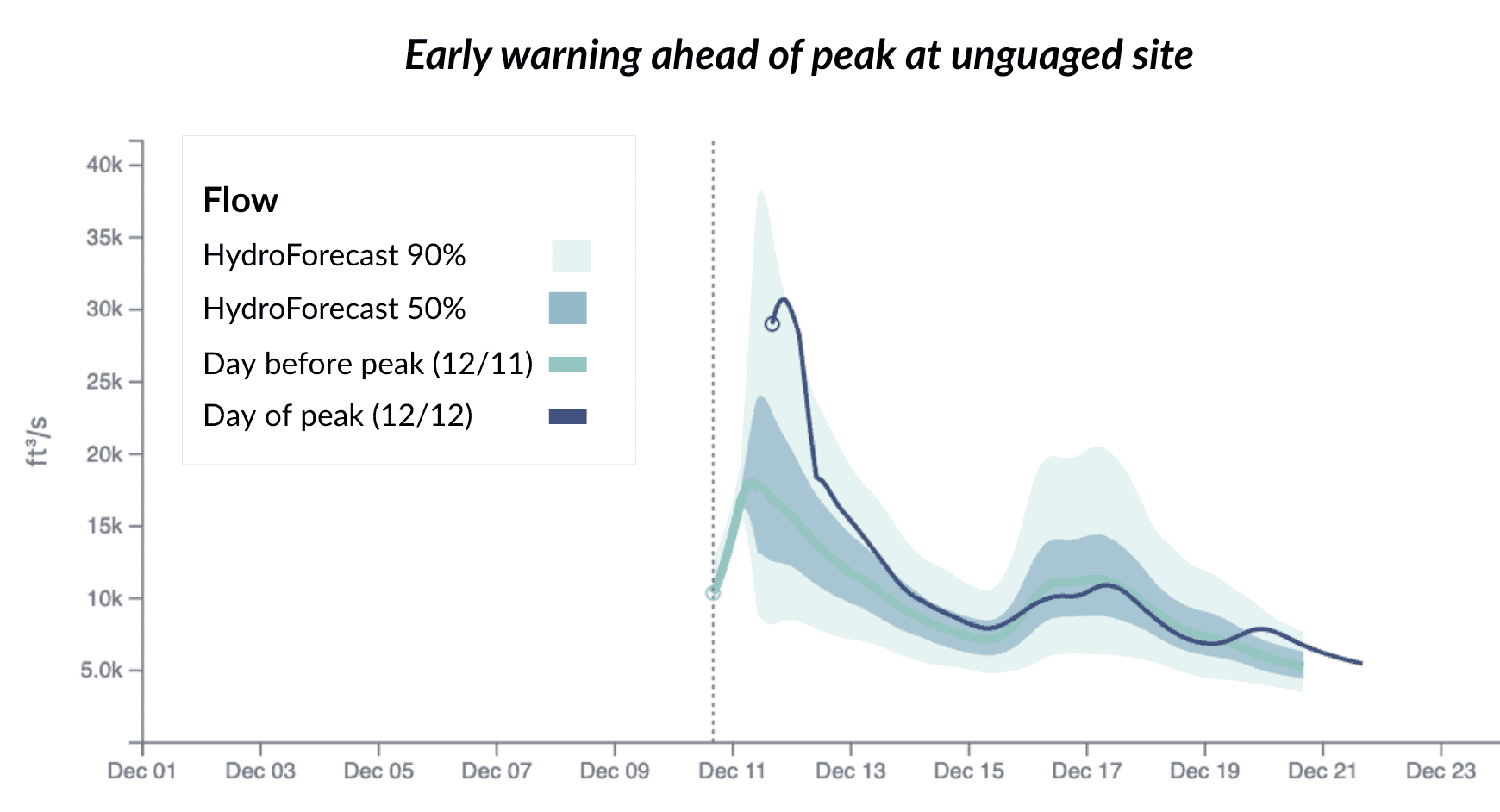
An ungauged forecast point in Washington state indicated the potential for extreme flows 3–4 days in advance. In the 1–2 days leading up to the event, HydroForecast’s confidence intervals encompassed the estimated peak flows of approximately 37,000–38,000 cfs observed on December 12, 2025.
During a series of historic atmospheric rivers in the Pacific Northwest, for example, ML forecasts provided decision support by helping operators anticipate rapidly changing inflow conditions across affected watersheds. These insights were provided at a combination of gauged and ungagued locations. In some cases, the ungauged forecasts provided by HydroForecast helped operators prepare for and stay on top of changing conditions during flooding of riverside communities.
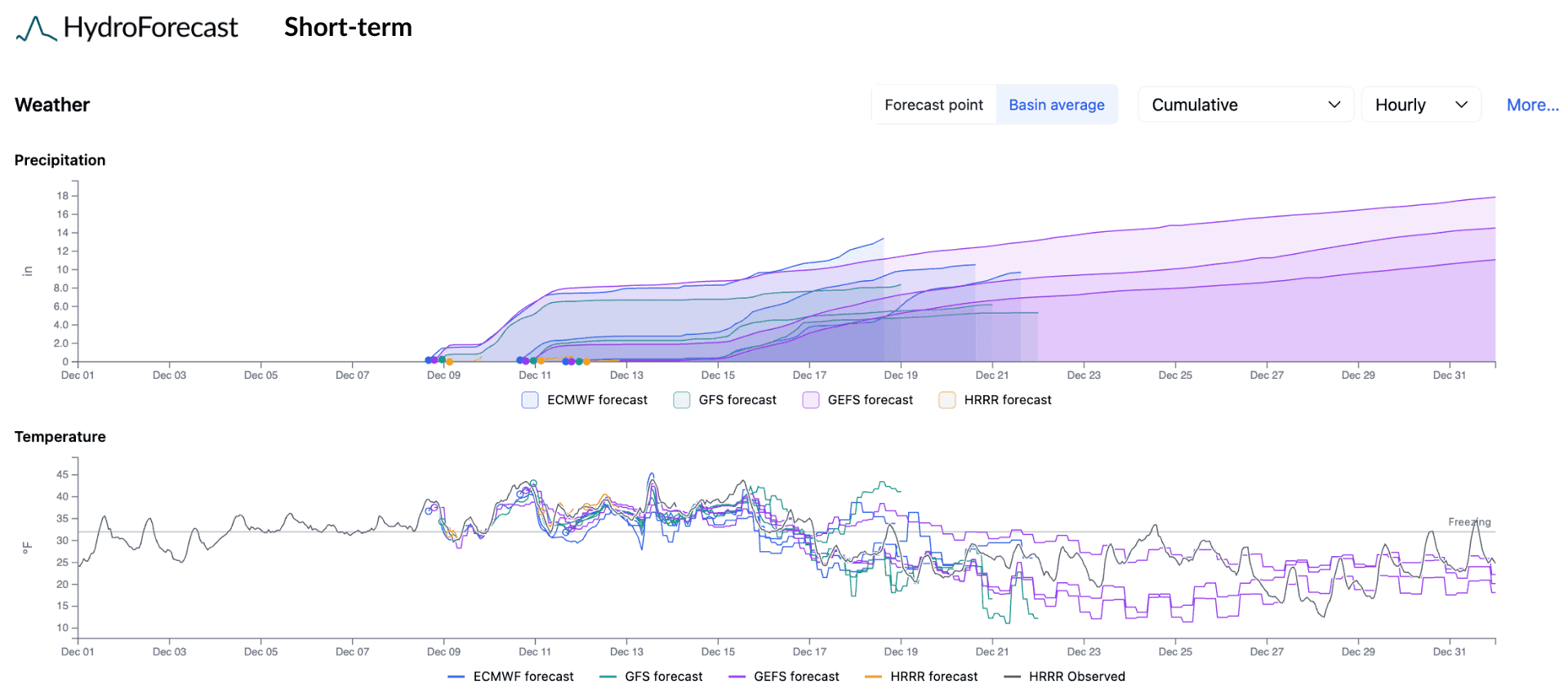
The HydroForecast platform surfaces key information at ungauged locations to improve situational awareness during high-flow events. The storms that caused flooding in Washington were warm atmospheric rivers, bringing heavy precipitation while temperatures were often forecast to remain above freezing. Differences among precipitation forecasts introduced uncertainty, but understanding the full range of possible conditions provided additional context ahead of the event.
Strengthen Dam Safety with Earlier Warnings
Dam safety teams routinely evaluate conditions across entire watersheds, not just at instrumented locations. During extreme events, understanding where runoff is being generated can be just as important as understanding conditions at the reservoir itself.
Forecasts are not a replacement for instrumentation, emergency action plans, or operational procedures. However, estimates of runoff originating from ungauged portions of a watershed can provide additional context when evaluating evolving hydrologic conditions. For many facilities, that means greater situational awareness and more time to prepare for changing inflow scenarios.
Extend Visibility in Snow-Dominated Watersheds
The story of sparse gauges is just as true for snow stations as it is for river gauges. Many hydropower systems depend on snowpack, yet snow monitoring stations represent only a small sample of conditions across complex mountain terrain. Significant portions of a basin may have little or no direct monitoring despite contributing meaningful runoff during spring and summer.
This creates a natural application for ungauged forecasting. By combining weather forecasts, snow observations, remote sensing products, and historical watershed behavior, machine learning models can estimate how snow stored across a broader landscape is likely to translate into future inflows. Used alongside traditional water supply forecasts and local expertise, these forecasts can provide additional visibility into portions of a watershed that would otherwise remain difficult to observe.
Looking Beyond the Monitoring Network
Hydropower operators will continue to rely on gauges, gauged forecasts, snow observations, and operational expertise. Those tools remain the foundation of reservoir operations.
Ungauged forecasts are best viewed as a complement to those resources. By extending visibility beyond the monitored network, they help operators better understand how water is moving through an entire watershed, not just the locations where measurements exist. The goal isn’t to replace the gauges, expertise, and public forecasts that operations depend on — it’s to fill in the gaps that they can’t see. For an industry managing increasingly complex conditions, that additional layer of watershed visibility supports better decisions at every scale, from daily generation planning to long-term dam safety.

