



 Back to All
Sponsored Content
The Columbia River Basin encompasses a wide swathe of the Pacific Northwest and is home to millions of migrating fish. Pacific salmon, sturgeon, shad and other species all journey from freshwater streams to the ocean and back again to complete their life cycle. Beyond its ecological importance, the Columbia River Basin is also a cornerstone of regional and national energy production, generating enough electricity to power several cities annually; a vital source for agriculture irrigation; and a navigation network that drives commerce, transporting over 60% of U.S. wheat to markets overseas.
Accurate, near real-time fish counts are essential for natural resource managers to balance these competing demands and ensure that fisheries can coexist with energy generation, irrigation, and navigation needs. However, such data are often hard won. Fish are counted at dams as fish migrate through engineered fishways, traditionally by in-person observers stationed at underwater viewing windows. This process is time-consuming, labor-intensive, and often logistically challenging—especially at remote dams where staffing is difficult. Passage rates can fluctuate dramatically, from a single fish per day to thousands per hour, depending on location and season.
BlueFish – The Future of Fish Monitoring
Our team has developed a more efficient and accurate way to enumerate fish passage. For the past six years, we’ve been advancing a computer vision-based system to count migrating adult fish as they move upstream through the Columbia River Basin. Working with our partner, MarineSitu, we have converged on a low-cost, modular, and site-tested solution called BlueFish.
BlueFish includes a specialized camera that can be set up in front of fish passage viewing windows. A ruggedized computer is connected to the camera on-site and deployed with a computer-vision model that analyzes real-time video footage to detect, track, and identify passing fish to the genus level. The algorithm also estimates the animals’ lengths to the nearest half inch. The resulting data can be readily summarized to produce counts at desired timescales, and evaluate distributions of fish size and species, as well as various other metrics. The system is also compact enough to be packed into a suitcase. To date, we’ve installed BlueFish at eight sites across the Columbia River Basin.
Data Quality Control
We have developed a mathematically robust and defensible quality control program that continually monitors a BlueFish deployment’s accuracy and enables timely adjustments that maintain data quality. The program employs expert fishery observers who remotely review short samples of video to continually compare the counts obtained by BlueFish to those obtained by a trained human observer. Results of these checks are evaluated continually using established statistical methods that document count accuracy and detect when drifts that require recalibration.
Additionally, BlueFish captures an image of each passing fish which can be viewed by fishery observers using a web-based interface to make difficult species-level identifications, such as differentiating between a Chinook and Coho salmon, checking for clipped adipose fins indicative of a hatchery-raised fish, and detecting injuries.
What’s Next?
We are expanding BlueFish’s capabilities to enable automated identification to the species level and automatic tracking of features such as clipped fins and scars. We also envision BlueFish being useful at hatcheries for counting juvenile fish. Finally, we’re working on an underwater version of BlueFish that can bypass the requirement for a viewing window.
Meet our Data Science Expert
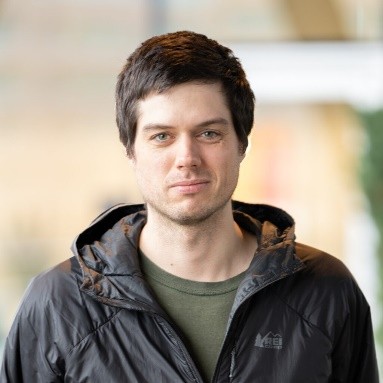
Elliot Koontz is an environmental data scientist with experience in quantitative ecology, computer programming, and natural resource management. He has led fish counting projects in the Columbia River Basin for the U.S. Army Corps of Engineers, municipal energy utilities, and private power companies. He has helped develop and maintain fisheries data systems for various clients in the Columbia River Basin.
Elliot previously worked with the Freshwater Ecology and Conservation Lab at the University of Washington and the U.S. Forest Service to evaluate impacts of wildfires on freshwater stream ecosystems in the Pacific Northwest. His background includes using a suite of quantitative tools, including generalized regression, multivariate ordination, linear and nonlinear optimization, and differential equations to model ecological populations in response to environmental conditions.
Elliot is based in Eugene, Oregon, and can be reached at [email protected].

