

 Back to All
*Sponsored Content
In the hydropower sector, where precision, durability, and sustainability are paramount, the steel casting industry is undergoing a profound transformation. At the center of this shift is Smart Production—a suite of technologies and processes that are redefining how cast components are designed, manufactured, and integrated into hydro infrastructure.
From automated workflows and robotic welding to 3D sand printing, Smart Production is enabling foundries to achieve new levels of efficiency, quality, and environmental responsibility. These innovations are not just improving technical performance—they are laying the foundation for a more sustainable future in heavy industry.
Smart Production: A New Era for Steel Casting
Smart Production combines digitalization, automation, and advanced manufacturing techniques to create intelligent, efficient production environments. In steel casting, this means moving away from manual, energy-intensive methods toward interconnected systems that optimize every step—from mold design to final inspection.
Key technologies include:
- Additive manufacturing (3D sand printing)
- Robotic welding and finishing
- Digital design integration and simulation
These tools are helping foundries reduce waste, improve consistency, and lower their carbon footprint—critical goals for industries supporting renewable energy infrastructure.
3D Sand Printing: Precision, Flexibility, and Sustainability
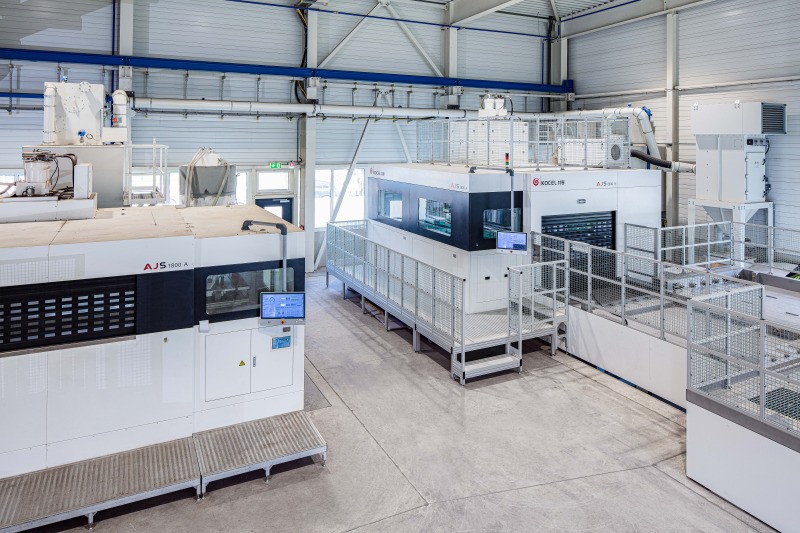
Among the most transformative technologies in modern foundries is 3D sand printing, which enables the creation of highly complex molds and cores directly from digital models—without the need for traditional tooling.
This innovation is revolutionizing how castings are designed and produced, offering:
- Unmatched design freedom: Engineers can create intricate internal geometries, optimized flow paths, and lightweight structures that were previously impossible or cost-prohibitive. Notably, 3D sand printing allows to produce monoblock runners—single-piece flow components that eliminate the need for welding. This not only improves structural integrity but also reduces post-processing time and energy consumption.
- Rapid prototyping and iteration: Design changes can be implemented quickly, accelerating development cycles and reducing time-to-market.
- Material efficiency: Only the required amount of sand and binder is used, minimizing waste and enabling easier recycling.
- Energy savings: The elimination of tooling and manual mold preparation significantly reduces energy consumption.
In hydro applications, where cast components often feature complex internal channels and high-performance requirements, 3D sand printing enables customized solutions that are both technically superior and environmentally responsible.
Robotic Welding: Consistency and Carbon Reduction
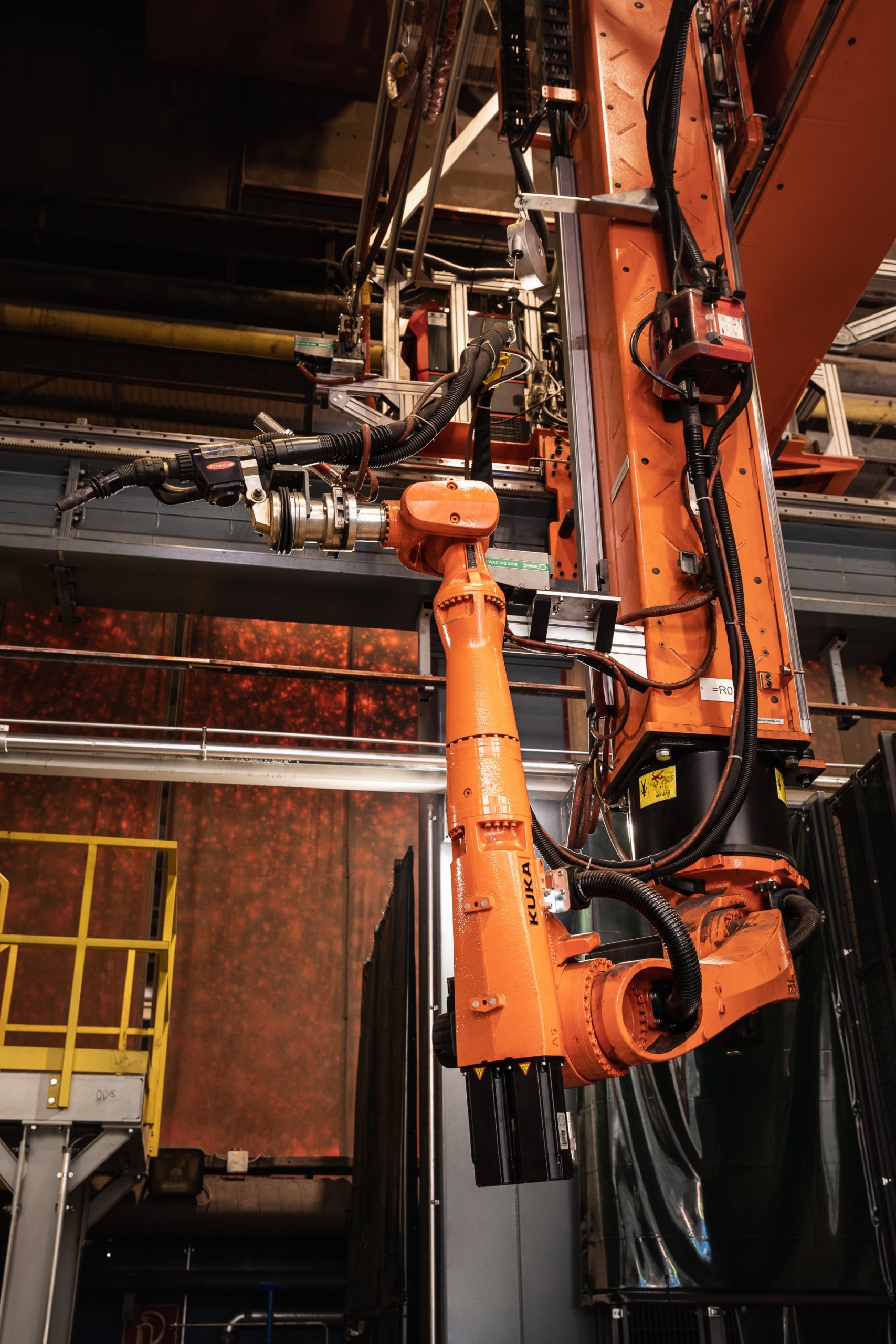
Welding is a critical process in the production of large cast components, especially in hydro applications such as turbines. Traditional manual welding, while skilled, can be inconsistent and energy-intensive.
Robotic welding systems offer:
- Uniform weld quality across batches
- Reduced rework and scrap rates
- Lower energy usage
- Improved safety and ergonomics
By automating welding tasks, foundries can ensure repeatable, high-quality results while significantly reducing the energy input and associated CO₂ emissions.
Sustainability: From Aspiration to Action
Steel casting has traditionally been seen as resource-intensive. But Smart Production is changing that perception. Through automation, additive manufacturing, and intelligent design integration, foundries are achieving:
- Lower CO₂ emissions per ton of cast steel
- Reduced material and energy waste
- Improved recyclability of sand and scrap
- Enhanced lifecycle performance of components
These improvements are especially relevant in the hydro sector, where long-term durability and environmental responsibility go hand in hand.
The voestalpine Foundry Group: Leading the Way
Among the companies driving this transformation, the voestalpine Foundry Group stands out as a pioneer in Smart Production and sustainable casting. With facilities equipped for robotic welding, 3D sand printing, and digital design integration, the group has positioned itself at the forefront of innovation in the steel casting industry.
Its commitment to sustainability is not limited to technology—it extends to process optimization, employee training, and cross-sector collaboration. By aligning its production strategies with the climate goals of the energy sector, voestalpine is helping shape the future of steel casting in hydro applications.
The group’s approach is holistic: every casting is engineered not only for performance but also for minimal environmental impact. This mindset has enabled voestalpine to set new benchmarks in sustainable manufacturing.
Conclusion: Smart Production as a Catalyst for Sustainable Growth
Smart Production is more than a technological upgrade—it’s a strategic enabler for sustainability, quality, and competitiveness in steel casting. By embracing automation, additive manufacturing, and intelligent design, foundries are transforming their operations and contributing to the broader goals of climate neutrality and resource efficiency.
The voestalpine Foundry Group is proud to be leading this transformation. Through continuous investment, innovation, and collaboration, it is helping shape the future of steel casting—setting standards not only for technical excellence but also for environmental responsibility.

