



 Back to All
*Sponsored Content
Fish ladders play a critical role in maintaining ecological continuity in rivers and streams interrupted by dams and other barriers. These structures allow migratory fish species such as salmon, steelhead, and sturgeon to bypass obstacles and reach upstream spawning habitats. Among the key components of fish ladders, the attraction pool is particularly crucial. It serves as the initial point where fish enter the ladder system, guided by water flow cues that mimic natural stream conditions. Properly controlling the flow into these pools is essential, and valves are an important part of this process.
THE ROLE OF VALVES IN ATTRACTION POOLS
Attraction pools rely on carefully balanced water flows to entice fish toward the ladder entrance. Too little flow, and the fish may not detect the ladder. Too much flow, and the water may be turbulent or create barriers that are difficult for fish to navigate. Valves provide the precise control needed to maintain these optimal conditions.
Valves in attraction pools regulate water from upstream sources, such as dam spillways or bypass channels, into the pool. They allow operators to adjust flow rates in response to seasonal variations, species-specific needs, or changes in river stage. Additionally, valves can isolate sections of the system for maintenance, preventing the need to drain the entire pool.
KEY VALVE TYPES FOR FISH LADDER APPLICATIONS
Several types of valves are commonly used in fish ladder attraction pools, each offering distinct advantages depending on the design and operational requirements.
Eccentric Plug Valves – Eccentric plug valves are an excellent choice for high-velocity control applications where cavitation could be a concern. These valves feature an off-center (eccentric) plug that rotates to open or close the flow path. The design minimizes contact with the seat during rotation, reducing wear and allowing the valve to handle high velocities without damage. Eccentric plug valves are ideal for flow control in large-diameter pipelines. Their low dynamic torque and cavitation resistance make them reliable for long-term operation in challenging environments.
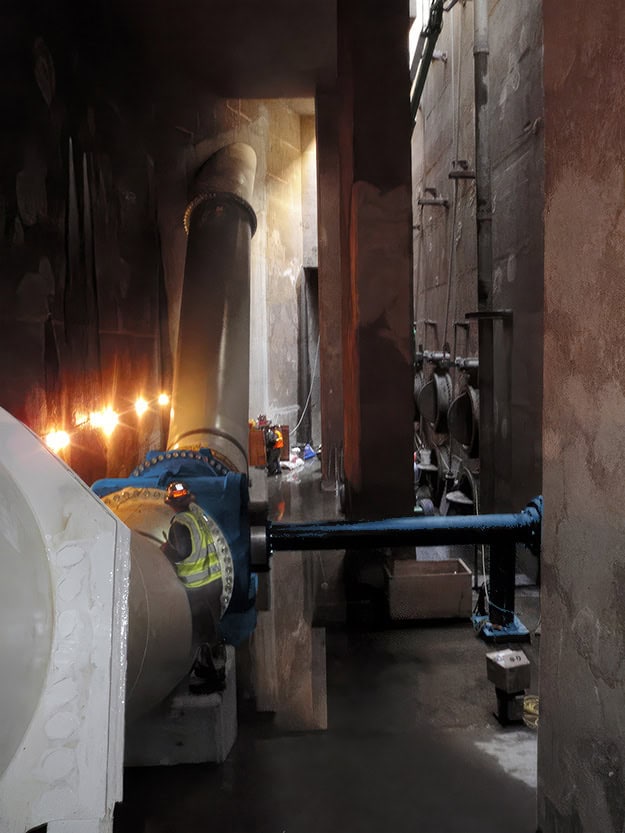
66 Eccentric Plug Valve – Fish Ladder: The Eccentric Plug Valve was found to be the ideal valve choice due to the high velocity and potential cavitation in this application.
Butterfly Valves – Butterfly valves are often used due to their compact design, ease of operation, and ability to modulate flow. They consist of a circular disc mounted on a rotating shaft. Butterfly valves offer tight shut-off and corrosion-resistant materials suitable for long-term service in freshwater environments.
Gate Valves – Gate valves are often chosen for systems where full open or full close operation is the primary need. A sliding gate inside the valve rises to allow flow or lowers to block it entirely. Gate valves provide reliable isolation when maintenance is required or when flows must be shut off completely. Due to their design, they handle sediment-laden water well, which can be beneficial in rivers with high silt loads.
Check Valves – Designed to prevent backflow, check valves ensure flow continues in the intended direction, preventing the pool from draining back into the river during low-flow periods or sudden surges. This is particularly important in multi-pool ladders where consistent upstream flow is needed to maintain passage conditions.
REAL WORLD EXAMPLE: DeZURIK ECCENTRIC PLUG VALVE AND HILTON KNIFE GATE VALVE IN ACTION
A West Coast engineering firm faced a challenging fish ladder design as part of a project for a public utility district. The ladder, constructed beside a dam, was intended to allow migratory salmon and steelhead to bypass the barrier and safely reach their spawning grounds upstream. The ladder featured a series of ascending pools that allowed fish to swim from pool to pool, ultimately reaching the river above the dam.
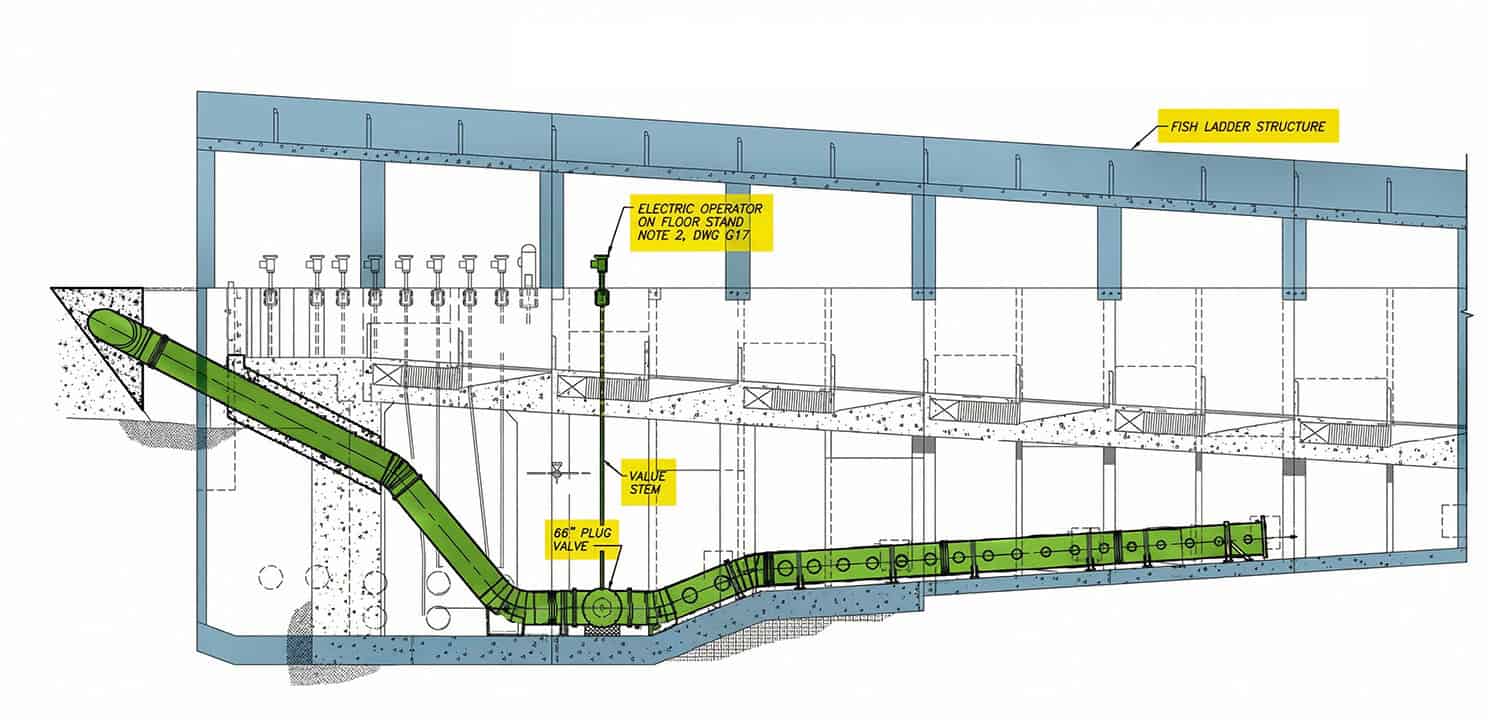
Fish Ladder Diagram: Diagram shows the 66″ DeZURIK Eccentric Plug Valve connected by a 55′ neck extension to a modulating electric motor actuator mounted on a floorstand.
In this project, the attraction pool was of particular concern. Water flow at the proper velocity is critical to attract fish into the ladder. The utility district needed a control valve capable of handling high flow capacity and the high velocity required by the application. The system included a 66-inch diameter pipeline feeding the attraction pool, with both a control valve and a separate isolation valve. The control valve needed to provide level control for the pool water, maintaining a six-foot elevation head differential to ensure proper flow velocity across the ladder steps.
After evaluating several options, the DeZURIK Eccentric Plug Valve was selected for the control function. The high-velocity nature of the flow, reaching 38 feet per second with a head pressure of 50 psi, posed a risk of cavitation, which can erode valve surfaces and reduce lifespan. Traditional butterfly valves were considered but rejected due to these extreme conditions. Other valve designs would have required costly modifications to the pipeline to accommodate velocity and pressure drop. The eccentric plug valve, with its low dynamic torque and cavitation resistance, was ideally suited to this high-velocity application.
The project also included a Hilton custom-fabricated knife gate valve, installed as a guard valve upstream of the attraction pool. The knife gate valve provided reliable on/off isolation, protecting the system during maintenance or emergency shut-off events. Its robust design is able to handle debris-laden flows and ensures the attraction pool can be isolated without disrupting upstream operations.
The 66-inch Eccentric Plug Valve was equipped with a gear unit and a modulating electric motor actuator with manual override. The actuator was mounted on a floorstand, connected to the valve in the pipeline below the fish ladder via a 55-foot neck extension. The valve was installed per DeZURIK’s recommendations, with the plug shaft horizontal and the seat downstream in a flow-to-close orientation. This orientation was determined through flow modeling to provide the longest possible valve service life.
Together, the DeZURIK Eccentric Plug Valve and the Hilton knife gate valve provided a comprehensive solution: precise modulation of attraction pool flow to guide migratory fish, reliable isolation for maintenance, and long-term durability in high-velocity, debris-prone conditions. This combination met the utility district’s goals and demonstrated how careful valve selection and design can optimize fish passage while ensuring operational reliability.
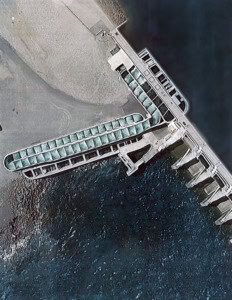
Fish Ladder – Overhead View: An aerial view of the fish ladder and the attraction pool. The water supply for the attraction pool is controlled with a 66″ DeZURIK Eccentric Plug Valve.
DESIGN CONSIDERATIONS
When selecting valves for fish ladder attraction pools, several factors should be considered:
Flow Range: The valve must accommodate both low and high flow conditions without causing excessive turbulence.
Corrosion and Material Compatibility: Valves are constantly exposed to water, often containing debris, minerals, or impurities. Materials such as stainless steel, ductile iron with protective coatings, or high-alloy wetted parts are commonly used to extend service life.
Actuation Method: Valves may be manually operated, electrically actuated, or hydraulic/pneumatic. Automated actuation allows operators to adjust flows remotely which is especially useful large installations.
Maintenance Access: Fish ladders are often in public or difficult-to-access locations. Valves should be designed for easy inspection, maintenance, and repair.
Sediment and Debris Management: River systems often carry sediment, woody debris, and other materials. Valves should be designed to resist clogging and minimize operational downtime.
CONCLUSION
Valves in fish ladder attraction pools are more than simple flow control devices—they are critical components that directly affect the success of fish passage. Real-world applications, such as the DeZURIK Eccentric Plug Valve in a West Coast fish ladder, demonstrate how proper valve selection ensures reliable operation, precise control, and durability under high-velocity conditions. By integrating modern valve technologies with careful design and environmental monitoring, engineers can ensure that migratory fish have a clear, accessible path to their upstream habitats, preserving biodiversity and supporting healthy river ecosystems.

