


 Back to All
Long before “grid flexibility” became an industry mantra, the concept for the Helms Hydroelectric Powerhouse was taking shape. The underground Helms Pumped Storage facility was ultimately commissioned in 1984 to meet a growing need for reversible pump-turbines—machines intended to add peaking power for increasing demand while helping balance nuclear baseload generation.
For PG&E, Helms was conceived as a solution to achieve large scale “quick load on” reserve as well as a strategic counterpart to the Diablo Canyon Power Plant—a 2,200-MW nuclear generating station that provided abundant, low-cost nighttime energy. This excess power allowed Helms to recharge on a daily cycle by pumping water into its upper reservoir and then using that water to generate during peak energy demand, supporting efficient and cost-effective operations.
At the time of construction, the Helms Pumped Storage Plant represented the leading edge of hydro technology. The generators and pump-turbines challenged the original equipment manufacturers, demanding uncommon precision and specialized expertise. The generator design incorporated advanced features for the era, including highly efficient ventilation coupled with water-cooled stator windings and specialized thrust bearings.
Meanwhile, the pump-turbines were among the largest and highest-head pumps in the world; in turbine mode, they offered an extremely wide operating range—from very low power levels with minimal cavitation up to full load.
Together, those innovations delivered exceptional output from a compact footprint, helping establish Helms as a benchmark facility of its time. As grid challenges emerged, the plant also adapted.
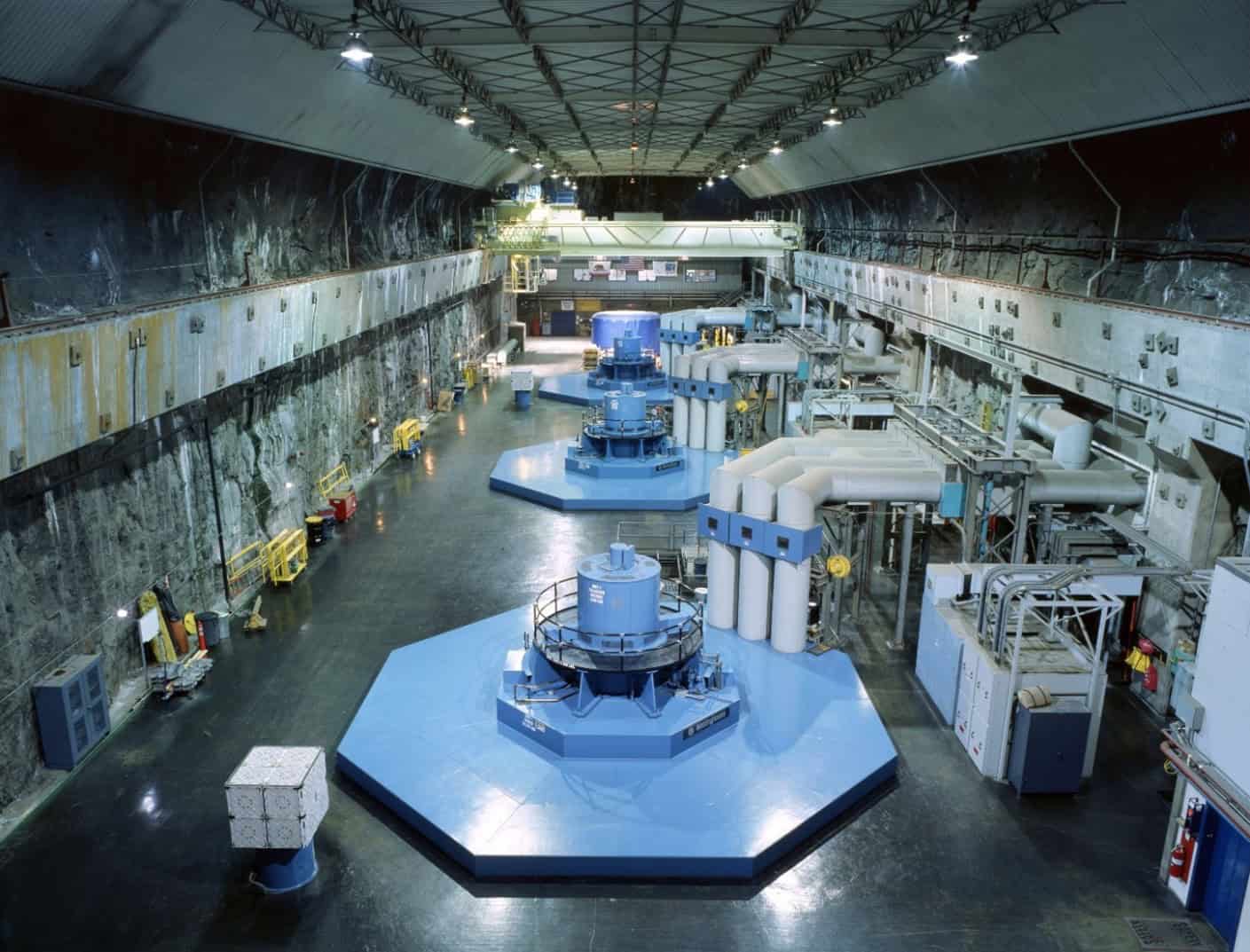
Helms Machine Hall (Photo Credit: Charles Bellenie of PG&E)
HOW HELMS IS MEETING THE MOMENT
Today, Helms’ mission has evolved to compliment the vast solar fields of California. As solar generation began to exceed daytime demand, Helms adapted by absorbing excess electricity—at times purchased at negative prices—to pump water and replenish the upper reservoir. The shift positioned Helms as a practical tool for managing renewable overgeneration and supporting grid stability during periods of abundant solar output. One of Helms’ greatest attributes is flexibility, and that capability becomes increasingly valuable as higher levels of renewables penetrate the grid.
Following more than four decades of reliable service to California, the facility’s key components now require significant refurbishment. It is time for life extension, modernization, and to identify uprate potential.
PG&E initiated studies to evaluate improvement opportunities, including whether additional hydraulic power could be captured from the power tunnel to increase generating capacity. Early results were encouraging, leading to deeper technical assessments of uprate potential for the existing turbines and generators. Subsequent findings indicated that the generators could be uprated and the turbines replaced with modern, highly-efficiency designs capable of delivering substantially higher output.
During planning, several pathways were evaluated including the addition of a fourth unit as compared to enhancing the existing machines with newer, larger components. Cost estimating showed that adding a fourth unit or comprehensively overhauling the existing machines with larger parts would require similar investment. While the combined approach could have increased total output further, it would also have required transmission-line modifications.
Given that refurbishment of the machines was already necessary, individual unit overhauls supported a phased construction approach allowing 2/3 capacity continued service to the grid during rework. PG&E ultimately chose to focus on upgrading the existing units without pursuing the fourth unit as the least cost and highest customer benefit option. The project is now in the engineering and procurement phase to make the project a reality.
Once complete, each of the three units is anticipated to increase in output by roughly 60 MW’s, with final capability shaped by the costliest and most technically challenging limiting components. The uprate target reflects several converging constraints. Transmission capacity effectively caps total additional output at about 180 MW presently; exceeding that threshold would require substantially greater investment. Likewise, maximum hydraulic turbine flow aligns well with the transmission limit. Importantly, the targeted increase remains within reach of the existing generator design, with several key modifications.
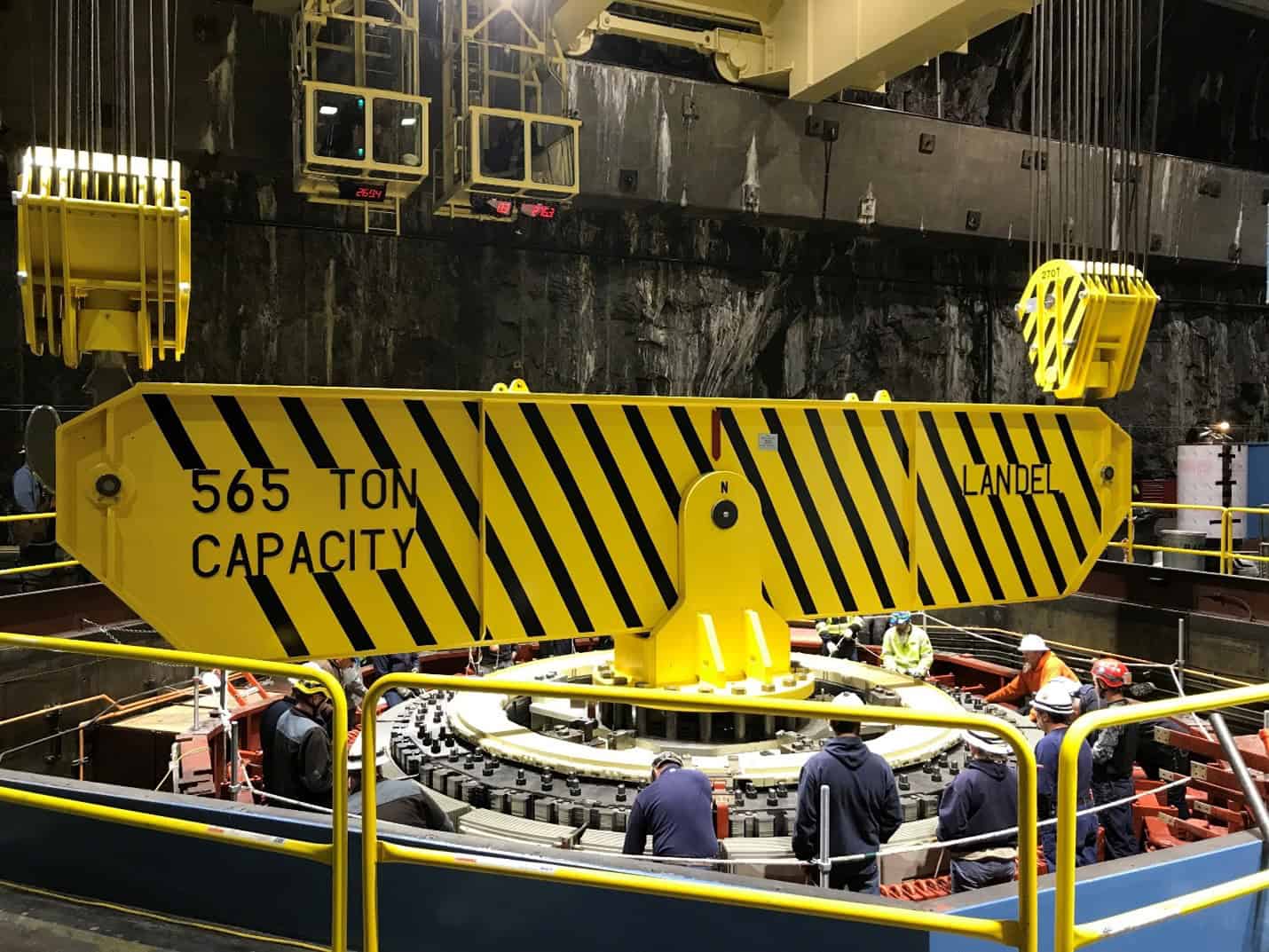
Helms Rotor Removal (Photo Credit: Ed Hanson of PG&E)
UNPACKING THE UPRATE
The uprate, life extension, and modernization scope extends well beyond turbine and generator capability offering a perfect time to address other legacy issues.
Key improvements planned as part of the work include:
- Removal of the 17,000-horsepower pony motor starting systems and replacing the scheme with a static frequency converter – SFC. This will modernize pump starting and add operational benefits by allowing a pump to go online much faster, retire equipment that would otherwise require overhaul, and eliminate multiple failure points.
- The generators will receive new windings to achieve the higher rated outputs. They will also receive new upper brackets and guide bearings, adding additional improvements to machine’s overall stability.
- Use of competitive model testing of the pump-turbines is intended to identify opportunities to expand the operating zone, improve efficiencies, and optimize total power input/output.
- The plant will receive dedicated 18,000 Amp generator circuit breakers. These breakers are an excellent fit with the new SFC pump starting system and improves Operations while enhancing Protection.
- Design to reduce very high fault currents using state-of-the-art, fast-acting current limiters and arc-resistant 18 kV medium-voltage switchgear to improve personnel and equipment safety.
- Installation of larger GSU transformers designed for use with natural ester oil (which has a much higher flash point than mineral oil), effectively eliminating the fire hazard due to oil ignition.
- Replacement of the existing 230-kV oil-filled cables in the shaft with solid XLPE-jacketed type, further improving personnel safety in the powerhouse.
WHAT COMES NEXT?
Other than power increase projects, the facility will undergo replacement of other major components in the next couple of years starting with the 8’ Turbine Shutoff Valves (TSV’s) in 2027.
The draft tube gates will be replaced with a new bonneted slide gate design that will require new tunneling in 2028.
Project uprate construction is expected to begin with the first unit in 2029.
These improvements to the facility will not only extend the project’s life and increase power output from 1212 MW’s to approximately 1392 MW’s, but will also improve flexibility, and once again make Helms “state of the art” for its time.
ABOUT THE AUTHOR
Ed Hanson is employed with Pacific Gas & Electric Company. He has worked in the utilities’ Hydroelectric Division for the last twenty years focusing on Project Engineering as well as a multitude of other roles within Hydro.
Ed received his B.S. in Electrical Engineering from California State University at Fresno in 2006. He has been a key figure at Helms PSP through many major projects and challenges ever since.
Ed’s present role includes technical support for the entire PG&E hydro fleet and is currently the lead engineer for the electrical projects included in the Helms Uprate portfolio. His dedication to hydropower technology is relevant to the value this great resource provides to the world.