



 Back to All
SPONSORED CONTENT
Along the Kentucky River, history is written in stone, steel, and water. For generations, a system of locks and dams shaped commerce and connectivity across the region. Today, those same structures are quietly taking on a new role, supporting the transition to renewable energy in ways that are both practical and powerful.
At Lock No. 14 near Heidelberg, Kentucky, that transformation is no longer theoretical. It’s real, measurable, and instructive for an industry searching for scalable, sustainable solutions.
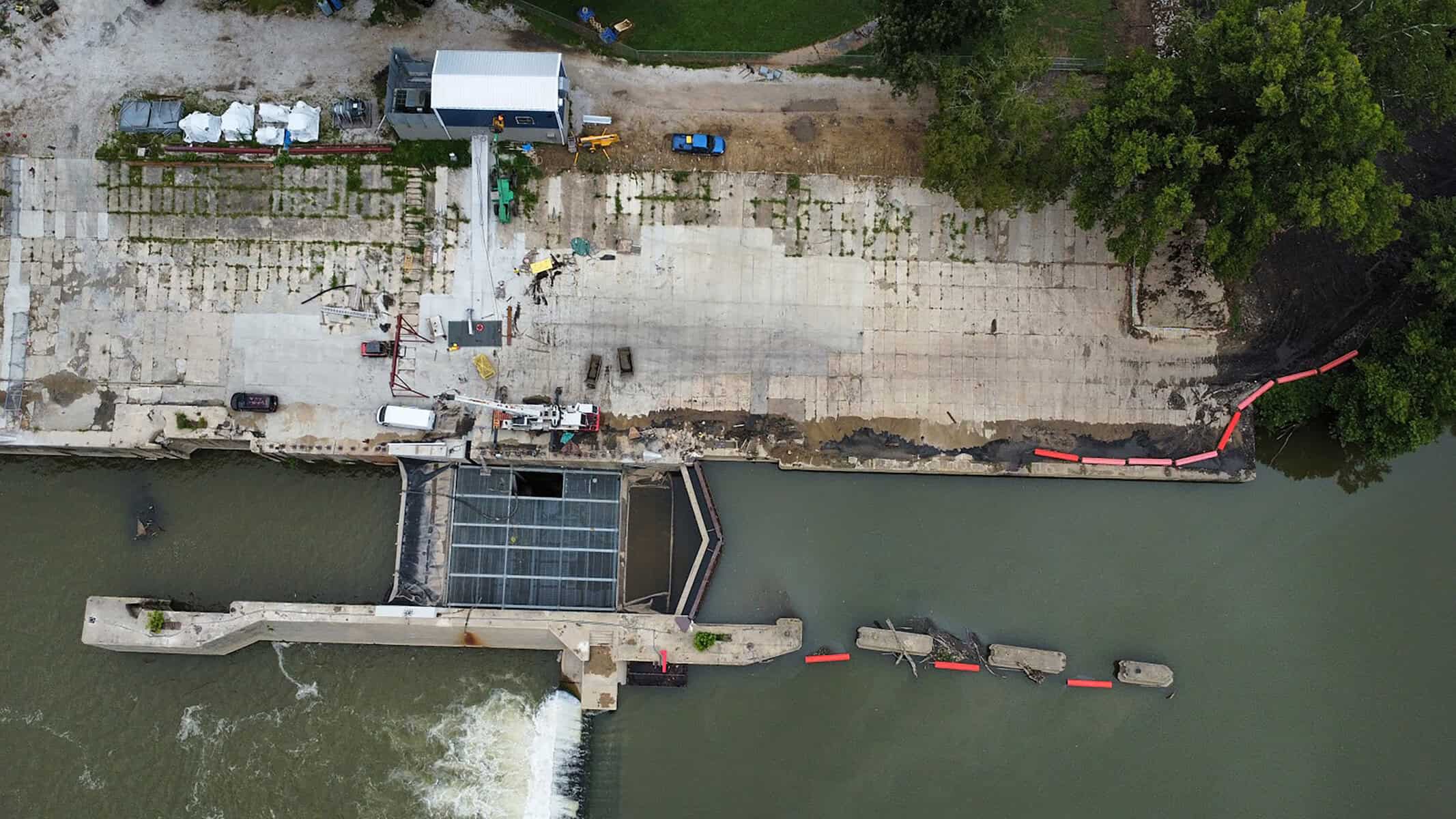
An overhead view of Lock No. 14 on the Kentucky River. (Photo Credit – Kleinschmidt Associates)
WHERE HISTORY MEETS OPPORTUNITY
For Appalachian Hydro Associates, the Kentucky River represents more than legacy infrastructure, it’s a corridor of untapped potential. The challenge at Lock No. 14 was not simply to generate power, but to do so in a way that respected the river’s dynamics, the historic structure, and the surrounding environment. The project also brought jobs and economic development to an area that has historically relied on the coal industry, which has now collapsed.
The site itself presented a compelling opportunity: an abandoned lock chamber with built-in hydraulic head. But it also came with significant constraints. Flood events in this stretch of the river can overtop the lock walls by more than 23 feet, creating extreme conditions that demand resilience, not just efficiency.
Rather than starting from scratch, the project team leaned into what was already there.
DESIGNING WITHIN THE LINES – INTENTIONALLY
One of the most defining decisions of the Heidelberg Hydroelectric Project was also one of the simplest in concept: keep everything inside the existing lock chamber.
By housing the entire powerhouse within that footprint, the team avoided altering a hundred-year-old lock structure by not adding structures that could alter upstream flood elevations, a critical consideration for both regulatory compliance and community impact. This approach also minimized in-river construction, reducing environmental disturbance and streamlining permitting.
It’s a reminder that innovation in hydropower doesn’t always mean building bigger. Sometimes, it means building smarter.
ENGINEERING FOR EXTREMES
Flood resilience wasn’t an afterthought; it was the design driver.
The facility was engineered to withstand overtopping flood events without compromising performance or safety by using submersible turbine-generators. That required careful attention to structural integrity, hydraulic behavior, and operational continuity under extreme conditions.
Instead of fighting the river, the design works with it, maintaining natural flow characteristics while protecting the facility itself. According to project materials, this approach ensures long-term operational reliability without introducing new risks to the surrounding system.
RETHINKING COMPLEXITY
Hydropower projects have historically relied on complex mechanical systems: headgates, trash rakes, and other components that require ongoing maintenance and introduce potential points of failure.
At Heidelberg, the team took a different path.
An underwater horizontal trash rack system eliminates the need for mechanical raking equipment altogether. A rubber dam maintains head pond elevation, and when deflated, flushes debris downstream more efficiently than conventional raking systems. By removing traditional headgates and simplifying the overall design, the project reduces both operational risk and long-term maintenance demands.
It’s a subtle but meaningful shift: designing not just for performance, but for longevity and reliability.
EFFICIENCY THROUGH RESTRAINT
Cost is often one of the biggest barriers to new hydropower development. Here again, the project demonstrates the value of working with existing infrastructure.
By building in the existing abandoned lock chamber, the team eliminated the need for a conventional coffer dam and reduced the need for new concrete while minimizing structural complexity. The result is a streamlined facility with lower capital costs, without sacrificing durability or output.
In fact, the project is expected to deliver approximately 30% greater power generation than the previous installation at a similar site, highlighting how thoughtful design can unlock additional value from legacy assets.
A MODEL FOR MODERN HYDROPOWER
What makes the Heidelberg Hydroelectric Project particularly compelling isn’t just its technical achievements, it’s what it represents for the future of hydropower.
Across the United States, thousands of non-powered dams and aging water infrastructure sites hold similar potential. The question isn’t whether these sites can generate power—it’s how to do so in a way that aligns with today’s environmental, economic, and operational priorities.
This project offers a blueprint:
· Leverage existing infrastructure to reduce cost and impact
· Design for resilience in the face of increasingly extreme conditions
· Simplify systems to improve reliability and reduce maintenance
· Respect the river by maintaining natural hydraulics
It’s a balanced approach that recognizes hydropower’s unique position in the renewable energy landscape—firm, flexible, and deeply connected to the waterways it relies on.
BRIDGING PAST AND FUTURE
Integrating a modern hydroelectric facility into a century-old lock structure required more than engineering expertise. It required a mindset, one that values preservation as much as progress.
By transforming an abandoned lock into a productive energy asset, Appalachian Hydro and Kleinschmidt have demonstrated how historic waterways can play a meaningful role in today’s clean energy transition. The project doesn’t erase the past; it builds on it.
And in doing so, it challenges a common assumption: that renewable energy development must always involve new footprints, new structures, and new impacts.
Sometimes, the most sustainable solution is already in place, waiting to be reimagined.
LOOKING AHEAD
As the hydropower industry continues to evolve, projects like Heidelberg point toward a more adaptive, resourceful future. One where innovation is measured not just by what we build, but by how thoughtfully we use what already exists.
For river systems like the Kentucky River, and many others across the country, that future is already taking shape.
—
To learn more about this project or explore how similar approaches could support your hydropower goals, visit: www.kleinschmidtgroup.com [email protected]


